


Robert Lukes

By RUSS BROWN • Photos By Matt Johnson

With the current focus on America 250, I recently had the pleasure of interviewing 103-year-old Robert "Bob" Lukes, a United States Navy World War II veteran (Lieutenant Junior Grade) who has lived in Louisville most of his life and now resides in a retirement community in the city.
Lukes was commissioned as part of the historic V-7 program and served in the Pacific Theater as an officer aboard the USS Saint Croix Attack Transport, in support of combat operations in territorial waters of Guadalcanal, Guam, New Guinea, and Leyte. He was also part of the "Magic Carpet Ride," the Navy's massive transport of more than 3 million troops home from the Pacific.
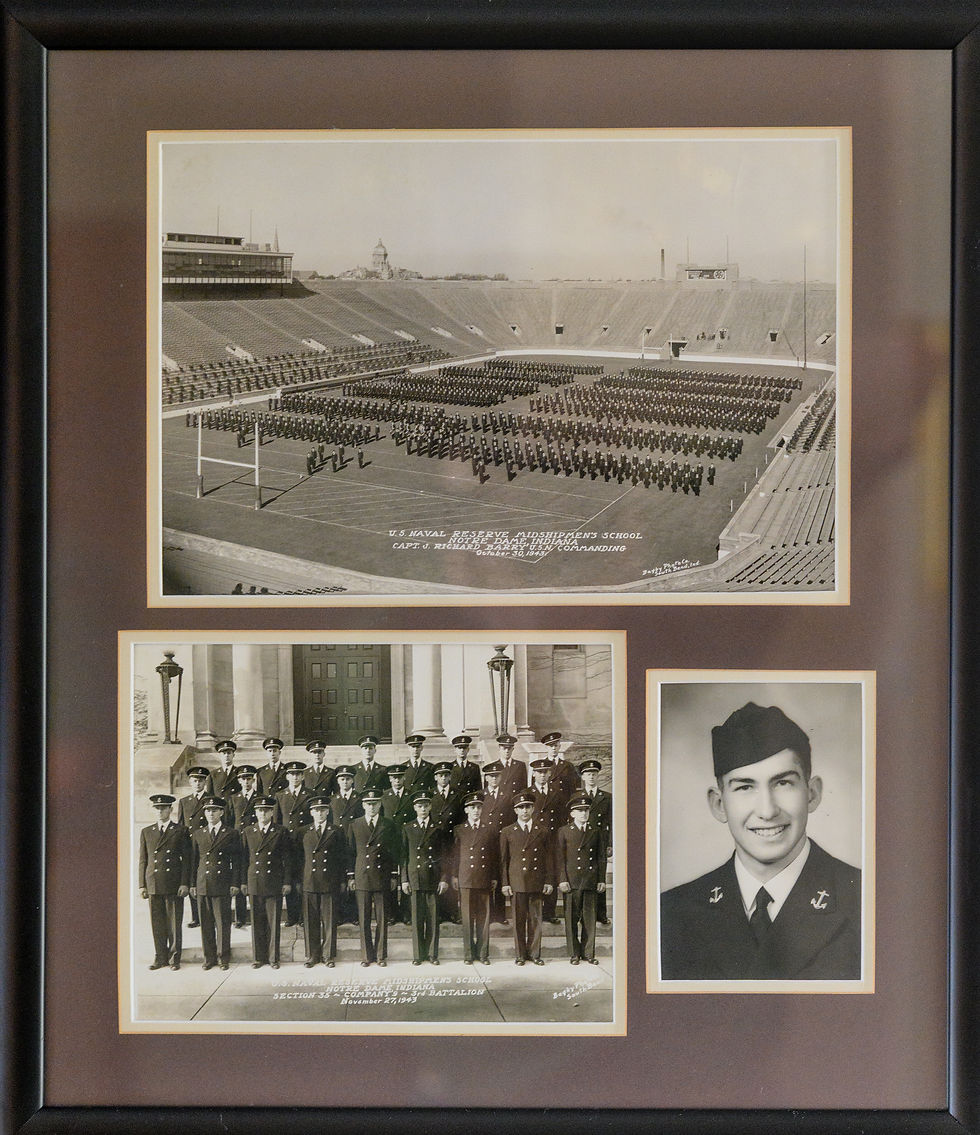
The Navy V-7 program was an expedited World War II-era U.S. Naval Reserve Midshipmen's School launched in June 1940 to rapidly train 36,000 reserve officers. The goal was to prepare officers for commands in the vastly expanding Navy fleet in preparation for a potential U.S. entry into the war.
Authorized by President Franklin D. Roosevelt, candidates were required to have a recognized college degree, with subsequent requirements adding specific math and science prerequisites. Following a 30-day indoctrination, candidates were put through an intensive 90-day officer training pipeline, commissioning them as ensigns in the Naval Reserve.
Trainees initially served one month at sea as seamen, followed by rigorous academic and tactical training ashore for three to four months.
As the son of a master machinist, Lukes grew up in California -- in Huntington Beach and San Francisco. He joined the U.S. Navy Reserve while working in the stock room of a hospital in Bakersfield before enrolling in the University of San Francisco, a Jesuit college, where he majored in chemistry.

Why USF? "Well, the number one reason was I got a free ride because the head nun at the hospital was a friend of the president," he said. "One thing I learned at a Jesuit school is you can never win an argument with a Jesuit." After graduating he was called to duty. "One day I was graduating, the next day I was on my way to the Navy."
He was sent to Notre Dame, one of six universities that served as V-7 training centers for the 90-day program. "I was made an officer and a gentleman," Lukes quipped.
He then specialized in electrical engineering in classes run by MIT before being assigned to the St. Croix ("we called the ship "the Crux"), where he was the officer in charge of radar operation and maintenance. That was an extremely important position, of course, even though he didn't see any combat.
"Our ship traveled all over the Pacific, but I never fired a shot in anger," Lukes said. "The Navy didn't want a ship in combat if they didn't trust the captain."
“He was in his 70s. I don't think I would have trusted him either," he joked.
"Dad had the good fortune of never being in combat," said his daughter, Marguerite, who lives in Brooklyn, N.Y. "They were moving 2,000 troops from one place to the other. But they still had to know where all the (enemy) ships were and there were some scary times for him with the radar."
After the end of the war, Lukes returned to Notre Dame on the GI Bill for his PhD in chemistry, embarking on the road that led to Derby City. While working in Erie, Pa., he got a job offer from General Electric in the mid-1950s and spent over 30 years in Appliance Park before retiring.
A question about what he liked about Louisville when he moved here gave Lukes another chance to exhibit his sharp wit. "The main thing I liked was getting out of Erie," he said with a grin. "Dreary Erie, the mistake by the lake."

Although his hearing and eyesight have become a challenge, as well as mobility, he enjoys watching KET programs and spending time outside when able.
Lukes, who has outlived three of his six children, has six grandchildren and five great grandchildren. A daughter, Anita, and two grandchildren live in Louisville. His neat, ranch-style home is filled with handiwork from his main hobby, woodworking -- including tables of various sizes, lamps, clocks, bowls. He also built quilting stands and frames for his wife, Mary, along with a cradle that has been handed down through five generations.

His talent in that area surfaced early, when he built a kayak while living in Bakersfield and used it for nocturnal explorations of the irrigation canals in the Central Valley near Bakersfield. Later in life, in addition to woodworking, he enjoyed traveling and volunteering as a reader for the blind.
He was commissioned as a Kentucky Colonel by Gov. Louie B. Nunn, and was appointed as a member of the Alternate Energy Project Review Committee by Gov. John Y. Brown Jr. in 1982.
Lukes has lived through three major milestone anniversaries in U.S. history: Sesquicentenial (1926); Bicentenial (1976); and Semiquincentenial (2026).


Basketball Stars is a thrilling sports game that offers gamers all around the world the vitality and thrill of basketball. Basketball Stars has grown to be one of the most played basketball games on mobile and online platforms thanks to its competitive gameplay, fluid controls, and fast-paced battles.