


I Can Only Speak For Me: A Conversation with Frank X Walker

By Kevin Murphy Wilson • Photos Provided

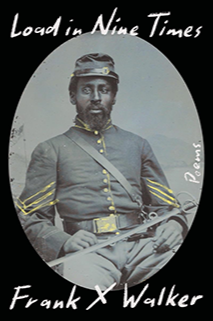
Frank X Walker is a giant figure within the literary world of Kentucky. In fact, this author, educator, visual artist, and “Affrilachian [a term he coined] poet” is the first African American writer to be named Poet Laureate of the Commonwealth. A steadfast promoter of this region’s arts and culture, the extremely prolific Walker has published numerous volumes of socially-conscious, historically-inspired writing, including a recent collection of poetry, Load in Nine Times, that gives (a powerful) voice to Black Civil War soldiers. Regularly recognized for his efforts, Walker’s many awards and accolades include a Lannan Literary Fellowship for Poetry, the Denny C. Plattner Award for Outstanding Poetry in Appalachian Heritage, the PEN/Voelcker Award, and the West Virginia Humanities Council’s Appalachian Heritage Award. Besides maintaining a vibrant professional practice, Walker is also a dedicated academic with several honorary doctorates to his name and a longtime high-profile gig as Professor of English and African American and Africana Studies at the University of Kentucky. We caught up with Walker ahead of his May 2026 speaking engagement at Kentucky College of Art + Design for a closer look at his craft.
VOICE-TRIBUNE: Can you tell us a little bit about your family background, education, and early influences as a writer and visual artist?
Frank X Walker: “I’m from a large family. I’m the second oldest of eleven kids from Danville, Kentucky. After graduating from Danville High School, I attended the University of Kentucky, enjoyed a 25-year career in arts administration, then attended Spalding University and began a second career as a college professor. Some of my early influences as a writer and visual artist were comic books, anything I could carry off the public library’s bookmobile, and witnessing my mother express her creativity.”
VT: Commenting on your Buffalo Dance project, the late great Gurney Norman said, “This is poetry and storytelling of high order,” which is big praise coming from him. What sort of relationship did you have with Norman? I was fortunate enough to count his pal Ed McClanahan as a friend and mentor but I only ever met Gurney in passing and in his work.
FXW: “Gurney Norman was my first fiction instructor at UK. It was my experience in his classrooms that convinced me to change my major from journalism to English/Creative Writing. I consider him my literary father. The press he started with his wife Nyoka Hawkins published my very first poetry collection, Affrilachia, in 2000. Eventually joining him on the faculty at UK is one of my highest honors.”

VT: Meticulous historical research seems to be a big part of your process. How do you normally go about it? And how deep do you go down the rabbit hole before you feel comfortable creating your own words for past occurrences?
FXW: “My collections of historical poems are grounded in research. It may take months of reading, a site visit, or being blown away by a variety of source materials before I even try to extract a poem from the process. I place a lot of trust in archival research. In addition toconsuming what already exists about the subject, I am most interested in rare and little-known details about a subject that might give me an original way into the narrative. The depth of my deep dives is directly proportional to how little I know or remember about a particular subject. I retraced a large portion of the Lewis and Clark trail and spent several summers on the Nez Perce reservation in Idaho to write about York [an enslaved man owned by William Clark who, by all accounts, became an indispensable member of the legendary expedition].
VT: As a writer, how do you know when something--whether it’s a poem, a story, or an entire volume is “finished?”
FXW: “It’s easier for me to acknowledge that a single poem is finished than an entire volume. I usually write up until I reach the deadline the publisher has given me before I can let go of a project. I have edited already published poems in the middle of reading it directly from the book.”
VT: Can you speak to the overlap between the work of an author and an activist?
FXW: “I don’t know that there is a natural overlap between being an author and an activist. I can only speak for me. My politics, values, and activism is part of who I am. I can’t take it off when I’m creating a piece of art. I don’t even try. Even when I’m writing in persona, and in other voices, it still shows up.”

VT: What was the impetus for your collection of multimedia art, “Black Star Seed: When Mi Cyaan Find Di Words?”
FXW: “That particular exhibit marked my return to visual art. It had been over thirty years since I’d exhibited any of my visual art let alone be featured in a solo exhibit. It also coincided with a new book release. As a multidisciplinary artist I used to struggle deciding what medium to express a new idea in. It’s very different to make art for the joy of making art versus making art and needing to sell it to eat. I missed all those years of not making visual art but I didn’t miss how hard it was to take care of myself and my family and maintain a studio. The decades plus spent administrating and supporting other artists were not wasted but it really allowed me to appreciate what a privilege it was to just make art, knowing that my full-time teaching job paid the rent.”
VT: You have been a long-serving professor at the University of Kentucky, and next month you will deliver the keynote address at Kentucky College of Art + Design’s commencement ceremony here in Louisville. Why, in your estimation, is higher education--particularly in the arts and humanities--so important for Kentuckians?
FXW: “I am a big proponent of continuing education and lifelong learning. High quality primary and secondary education and post-secondary education is just part of the solution to raising the quality of life for the entire community. I ran Kentucky’s Governor’s School for the Arts for almost ten years and it was very satisfying to see the students leave the program and return to their home communities so much richer in so many ways. I know a quality education, especially an arts intensive one, can be life changing.”
VT: In this day and age, and at this point in your career, how do you measure success? Also, looking back, what are you most proud of?
FXW: “In this day and age, I’m happy to still have an audience. I’m not done yet, and I’d like to think my best work is still ahead of me, but my measuring stick for success only quantifies the growth of my students and the development of my children and their children. If I must measure my own success I’d point to Kristine Yohe’s new book, Reckoning With the Past: The Historical Poetry of Frank X Walker. Having previously been the subject of multiple thesis and dissertations over the years, a whole book about my work feels much more substantial. It is definitely something I am very proud of.”
For more information visit: www.FrankXWalker.com.


192.168.33.1 is a useful networking keyword that connects with the broader idea of global connectivity. This article highlights how entrepreneurs can build meaningful relationships, exchange knowledge, discover opportunities, and create valuable partnerships through strong international networks.
What I like most about Drift Boss is how it turns a simple drifting concept into a skill-based experience that rewards focus and consistency.
Snow Rider 2 stands out with its smooth controls, which are easy to learn but difficult to master as the speed increases over time.