


A growing monkey family: Louisville Zoo celebrates colobus monkey birth

Press Release
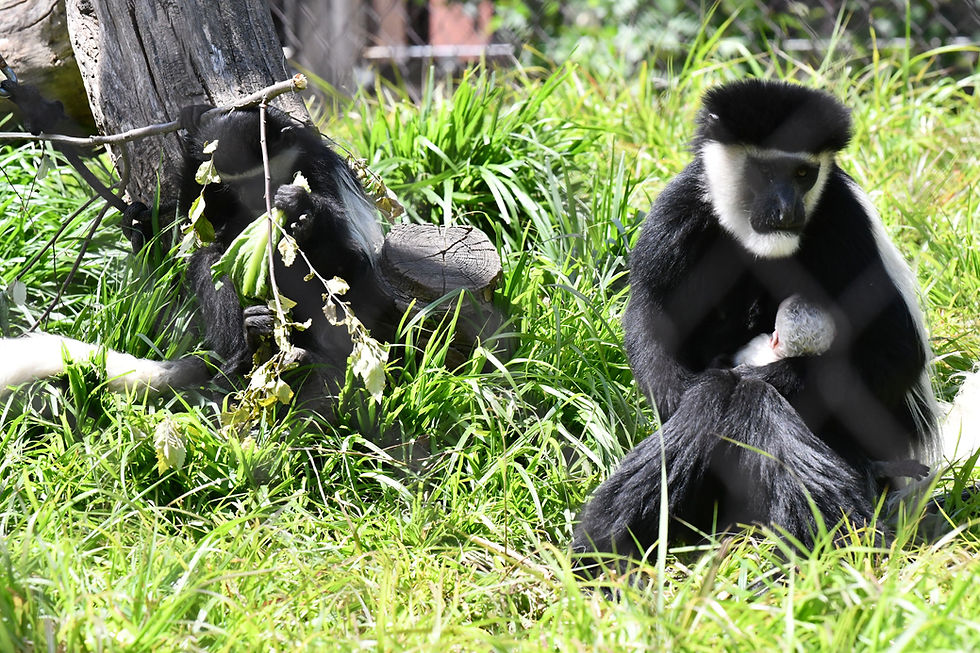
Louisville Mayor Craig Greenberg and the Louisville Zoo are celebrating the birth of a colobus monkey at the Zoo.
In the early hours of Thursday morning, May 7, 6-year-old female “Ate” (pronounced “ah-tay”) gave birth to a healthy boy. The father is 13-year-old “Dr. Sheldon Cooper.” Both mother and baby are thriving. In addition to his parents, the new addition will receive nurturing support from “aunties” Nali and Phyllis. Colobus monkeys have an impressive social structure where other troop females help raise the offspring.
“What an exciting week it’s been as we’ve welcomed a baby giraffe and now a baby monkey to our Louisville Zoo,” said Mayor Greenberg. “This is a perfect time to get your membership or make a visit to meet our newest additions to the Louisville Zoo family.”
This is just the second colobus monkey birth in the Zoo’s 47-year history. The first-ever birth was celebrated in 2025 with the arrival of male primate, Kayin George.
“Every new birth at the Zoo is special, and seeing this troop welcome and care for a new infant has been incredible to watch,” said Dan Maloney, Louisville Zoo director. “This youngster is already surrounded by a strong family group, and we’re excited for our guests to follow his journey as it grows. With a giraffe calf born and an Steller’s sea eaglet hatched in the last month, we’re excited to share more of what the season brings.”
Facts and Family Dynamics
Colobus monkeys, native to the African rainforest canopy, are highly arboreal and rarely come down from the trees. One of their most remarkable behaviors is alloparenting, where females share in babysitting duties from the moment an infant is born.
Infants play a vital role in colobus troop life, fostering unity and interaction among all members. This collaborative care system not only helps young monkeys thrive but also enriches the lives of the entire group.
From Snowflake White to Black-and-White
Colobus babies are born with a snowy white coat — a striking difference from the black-and-white coloration of adults. By six months, the baby’s coat will match the adult pattern.
Colobus babies are precocial, meaning they are relatively mature and physically capable soon after birth. Within just a couple of months, they begin to explore their environment, navigating the treetops with increasing agility.
These primates have hook-like fingers but without thumbs, which makes leaping and climbing more efficient. They also enjoy a primarily leaf-based diet and are known for their distinct vocalizations used to communicate across the canopy.
Plan Your Visit
Now is an especially exciting time to visit the Louisville Zoo. Guests may spot the newborn monkey in both the indoor and outdoor areas of Colobus Crossing, where the troop’s playful interactions and cooperative care are on full display. Guests should look for a white head tucked under the arm of mom and other troop members. Visitors to the Zoo may also see the latest Steller’s sea eagle hatching on the live camera in Glacier Run. In addition, the newest Masai giraffe addition will be available for viewing in the coming days. Stay tuned for more exciting arrivals coming in 2026!
Zoo Hours
The Zoo is open daily year-round. Spring/summer hours are 10 a.m. – 5 p.m. (stay until 6 p.m.). The Zoo is closed on Thanksgiving, Christmas, and New Year’s Day. For more information, visit louisvillezoo.org.
###
About the Louisville Zoo
The Louisville Zoo, the State Zoo of Kentucky, is the top, non-profit, paid attraction in the state. The Zoo is dedicated to bettering the bond between people and our planet by providing excellent care for animals, a great experience for visitors, and leadership in scientific research and conservation education. The Zoo is accredited by the Association of Zoos and Aquariums (AZA) and is a member of the World Association of Zoos and Aquariums (WAZA), a global alliance of zoos and aquariums.


What a delightful update on the colobus monkeys! Their social structures and nurturing behaviors are fascinating. It makes me think about how interconnected all species are, much like communities forming around shared interests. With the recent buzz surrounding ragdoll hit culture, it's interesting to consider how different groups can cultivate support for wildlife conservation within their networks. Would love to see more initiatives connecting these themes!
Revisar la lotería la primera del mediodía ofrece una forma práctica de conocer los resultados. Comprobar números y datos publicados permite identificar la jornada correspondiente y consultar la información de manera rápida y sencilla.
Players must carefully avoid collisions in Snow Rider, as a single crash immediately ends the run and starts a new challenge.
Wonderful news! Every new addition to a zoo is a reminder of how important conservation calcsolver efforts are. Congrats to the Louisville Zoo!
The photos are adorable! It's always exciting to see successful births at zoos, and stories like this remind us how important wildlife conservation really is. Moto X3M unblocked game site has also been one of the sites I visit regularly.